
Webinar: Unlock the Full Potential of FlightRisk with ARINCDirect
As an ARINCDirect customer, you have FREE access to FlightRisk.
FlightRisk works seamlessly with ARINCDirect to help you analyze safety risks as part of your flight planning process. FlightRisk enables you to easily identify and address potential hazards, ensuring you have the information you need to stay safe and prepared before flight.
To learn more about using FlightRisk via ARINCDirect, register for this July 8 webinar: Unlock the Full Potential of FlightRisk with ARINCDirect.
See how other ARINCDirect customers benefit from using FlightRisk:
Case Study: H-E-B Flight Department – Pursuing Continuous Improvement for 5-Star Service
Case Study: Delivering a Safe and Exceptional Flight Experience at Davinci Jets
Want to learn how to benefit from the lessons learned of others? See how FlightRisk helps facilitate that:
Case Study: Safety Sharing Lifts All Flight Departments
ARINCDirect Administrator Settings: Enabling Default FlightRisk Assessments for All Flight Plans
Company administrators can automatically include a FlightRisk assessment for every flight plan. Click on “My Company” > “Tails” > then select a tail.
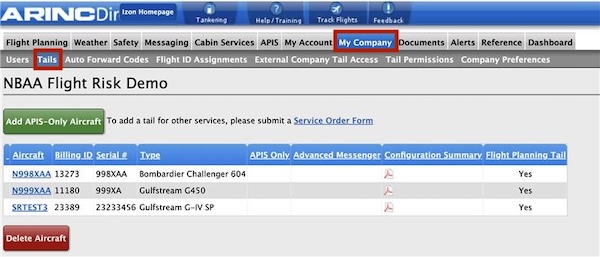
The default options for FlightRisk are contained in the Tail Profile of each subscribed aircraft. Click on Summary to run a FlightRisk assessment by default for each flight plan computed for that aircraft. After clicking Summary, save the aircraft profile to retain your changes.
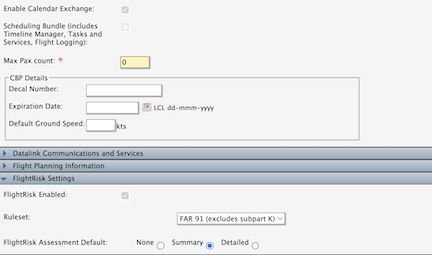
Vanguard 2026: Safety by Choice, Not Chance
Save the date! The VOCUS Vanguard Forum returns for its fourth year, June 9-11, 2026 at the W Hotel in Scottsdale, AZ.
The event starts with an evening social on June 9, followed by two full days of safety-centered thought leadership, networking, and education.
This year’s theme is Safety by Choice, Not Chance.
While chance introduces uncertainty, professional aviation depends on predictability. “Safety by Choice, Not Chance” highlights how disciplined decisions, strong culture, psychological safety, and data-driven insights help teams shape outcomes – even in complex, fast-moving environments. In other words, small choices accumulate into organizational resilience and thoughtful processes reduce variability across every part of an operation. These ideas will be the foundation of our 4th annual Vanguard Forum.
Here’s what you can expect:
- Polaris Aero State of the Union
- Thought Leadership Session
- Customer Panels (Operators, FBOs, MROs, MX Departments)
- Guided VOCUS Training & Deep-Dives
- New & Upcoming Features
- Peer-to-Peer Knowledge Exchange & Networking
- Live! Helpdesk
Join us as we explore what the most resilient operators are doing differently and how intentional decision-making prepares your team for the moments that matter most.
Detailed agenda to be posted prior to the event.
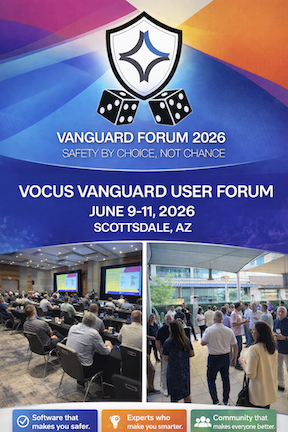
VOCUS Vanguard 2026
The VOCUS Vanguard Forum returns June 9-11, 2026 at the W Hotel in Scottsdale, AZ.
The Value of Safety Program Support from your Insurer
As an operator, you continually focus on ensuring the highest level of safety. In addition, you strive to meet regulatory and audit standards (e.g., FAA, IS-BAO, BASC) by adopting various safety programs. But did you know that your insurer could be a valuable resource in helping you start, enhance, and accelerate your safety journey?
Improving a safety program reduces risk for everyone, including the insurance industry. As a result, many insurance companies offer assistance in acquiring safety products and services. Since many insurers differ in what they can offer, it’s important to ask about available safety benefits when renewing your insurance policy. These safety benefits can be applied to your current safety program or in obtaining new safety products and services.
Polaris Aero is a participant in several safety assistance programs with many insurers. If you’re not yet a VOCUS customer, insurers may provide financial assistance to help you get started with one of the VOCUS Safety Intelligence applications (VOCUS SMS, FlightRisk, GroundRisk).
These benefits don’t just apply to new customers; they also apply to existing customers. You can use insurance benefits to add an additional VOCUS application, VOCUS add-on (e.g., ASAP, FOQA, Fatigue), or Safety Services (e.g., safety culture surveys, safety program optimization).
If financial hurdles have been holding you back from enhancing your safety program, check with your insurer about the benefits available. Polaris Aero is a participant in several insurance safety assistance programs.
If your insurance provider is not listed or to find out more about available benefits, email us.
FARGO JET CENTER LAUNCHES NEXT GENERATION SAFETY MANAGEMENT SYSTEM WITH POLARIS AERO VOCUS
Polaris Aero is Early Adopter of FAA’s New NOTAM Management System
Does 2 + 2 = 4?
In data analysis, numbers can be used to ‘measure’ things in different ways. These measurement systems – Nominal, Ordinal, Interval, and Ratio – tell us how precisely variables are recorded, and more importantly, they determine what level of insights can be derived.
When analyzing data, it is critically important to understand how – and when – to use each type of measurement system. Choosing the wrong one could have profound consequences, especially when assessing risk.
Nominal scales are used to describe (or identify) things. They are not really numbers in the mathematical sense; they are more like labels. Objects are “measured” by determining the categories to which they belong. Eye color, blood type, and nationality are common examples.
Ordinal scales are used to rank-order objects. These systems tell us that one item may be more – or less – than another, but we cannot state by how much because there are no fundamental units we can use to compare things. The interval between each unit may be different. A common example is the Likert Scale: the difference between “strongly agree” and “agree” is practically impossible to determine.
Interval scales are like ordinal scales; except they have defined units. Therefore, the intervals between each value are equally split. A common example is the Celsius temperature scale. Each temperature unit – degree– is the same.
Ratio scales are interval scales (i.e., they have fundamental units) with a true zero point. This scale allows us to do the math we learned in grade school: we can multiply, divide, add, and subtract. This is the measurement system that allows us to compare objects using ratios. Common examples are distance and money.
What Does This Mean for Hazard Scoring Systems?
Hazard scoring are ordinal measurement systems. They rank order hazards, usually on a scale from ‘1’ (the lowest category of risk) to ‘5’ as the highest category of risk. There may be many hazards in the ‘5’ category, but do they have the same level of risk? Is a flight in severe icing equal to a flight at night? Of course not! In addition, since there are no fundamental units in ordinal scales, we cannot add hazards together. A pop-up trip (level ‘3’ hazard) at twilight (level ‘2’) hazard does not equal severe icing (level ‘5’ hazard).
Treating ordinal data like ratio data can have severe consequences. By understanding the different types of measurement systems – and their inherent limitations – we can make more effective decisions.
Question: Does 2 + 2 = 4?
Answer: Yes, IF you are using Interval or Ratio measurement systems.